
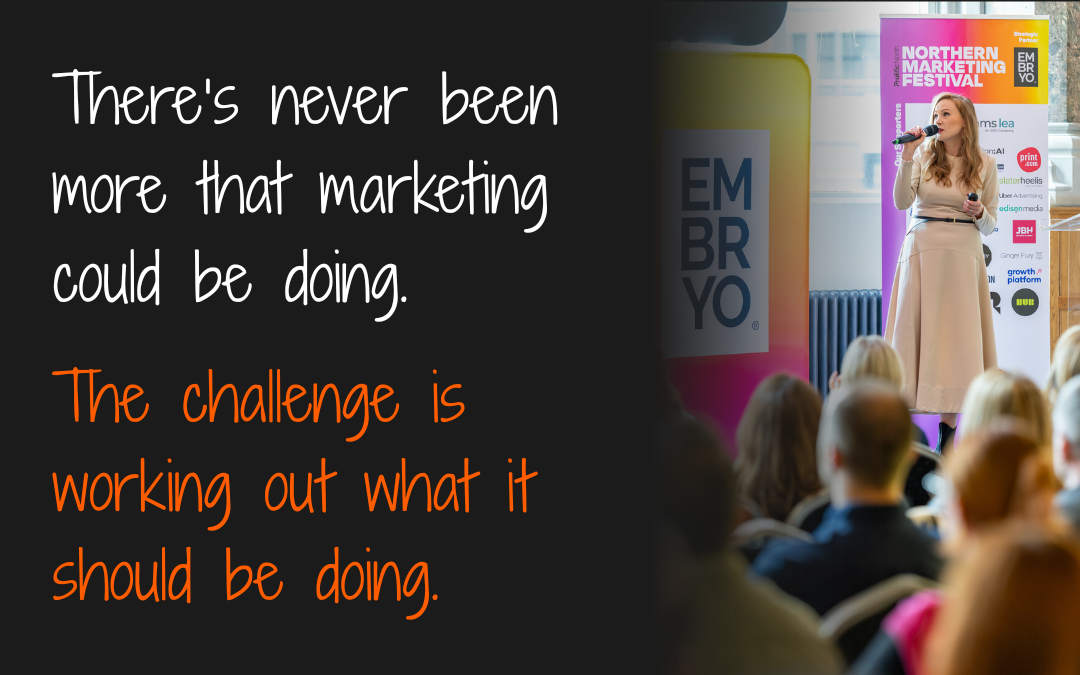
Ginger Fury founder Jay Dickinson explains why putting the customer at the heart of prioritisation can help marketing teams cut through the noise – and turn customer insight into action.
Marketing in 2026 is hard, right?
There are hundreds of channels to choose from, thousands of brand touchpoints and an increasingly fragmented customer experience.
Our marketing tech stacks are constantly evolving, promising one-to-one personalisation while the reality of actually implementing it is somewhat trickier.
We’re sitting on valuable customer data we know we should be doing more with, if only we had the time to find the insights and actually activate them.
Meanwhile, consumer expectations keep rising and internally we’re being asked to do more with less.
The FD wants to know whether we really need to spend that money on brand marketing. Sales wants us to email absolutely everyone in the database because there’s a 50% off offer and targets need hitting. The CEO is annoyed because his mate Googled the business at the weekend and we weren’t number one.
And then there’s Sheila.
Sheila doesn’t work in marketing, but she did an AI course at the weekend and has helpfully rewritten your entire website in 20 minutes on Claude.
Thanks, Sheila.
So, who’d be a marketer in 2026?
We don’t need more ideas
The problem isn’t that marketing teams don’t have enough things they could be doing.
Quite the opposite.
Marketing doesn’t have an ideas problem. It has a prioritisation problem.
And when we struggle to prioritise, we tend to end up in one of two places.
The first is paralysis. We don’t really change anything. We keep doing what we’ve always done, perhaps shifting a bit of budget around the edges.
The second is chaos.
Everyone starts doing more stuff because we need to be seen to be doing more stuff. Different teams, agencies and departments race off in different directions. Activity multiplies, but very little joins up.
None of the individual activity is necessarily bad. In fact, much of it could be effective.
The problem is that nobody has properly agreed what matters most.
So, how do you decide?
There are plenty of established prioritisation frameworks. Impact versus effort. Urgent versus important. They’re useful tools and we’re certainly not suggesting you chuck them in the bin.
But there’s another lens we think marketing teams should be using far more often:
The customer.
What if the customer decided your priorities?
When we say “customer”, we’re not only talking about somebody who has already bought something from you.
We’re talking about real-life human beings.
In marketing we’ve spent years calling people “consumers”, which carries an interesting assumption: that they’re there to consume our things. Our products. Our advertising. Our content.
“Customer” encourages us to think differently.
They’re not there to consume what we produce. We’re there to serve them.
So being customer-first means looking at their world rather than ours.
What are they trying to achieve? What are they worried about? What do they believe to be true? What is happening in their life? What gets in their way?
And, importantly:
Where can our brand genuinely be useful?
It sounds obvious. Understanding your customer is hardly a revolutionary new marketing principle.
The problem is what happens to that understanding next.
The 50-page customer insight deck isn’t the answer
We’ve seen this plenty of times.
A project begins with customer research. Everyone reads the insight deck.
There are nods around the room.
This is really interesting.
We need to put the customer at the heart of what we do.
We should definitely use this.
And then the 50-page deck gets put in a drawer – literally or metaphorically – and everyone goes back to the operational reality of their jobs.
- The CRM team thinks about CRM.
- The social team thinks about social.
- The media agency thinks about media.
- Sales thinks about sales.
Budgets, teams, projects and agencies all sit in nice, neat silos.
There’s just one slight problem.
Your customer doesn’t experience your organisation in nice, neat silos.
They experience the sum of all the interactions they have with you – alongside everything else that’s happening in their world.
Their reality is messy.
So if customer insight is going to genuinely change your marketing, it can’t simply sit at the beginning of the strategy process.
It has to make its way all the way through planning, prioritisation and, crucially, delivery.
One of the tools we use to do that is customer journey mapping.
Your marketing funnel isn’t your customer’s journey
“Customer journey” can mean lots of things to different organisations.
So let’s start with what we don’t mean.
A marketing funnel isn’t a customer journey.
Funnels are useful. They can help you understand the wider commercial landscape, the proportion of prospects at different stages and what that might mean for your sales pipeline.
But customers don’t wake up thinking:
Excellent. Today I shall move from awareness to consideration.
Funnels describe the business’s view of the customer.
Not the customer’s view of their life.
The same goes for a map showing every interaction somebody has with your brand. That’s useful too – and we use them – but it’s still only showing the bits of their life that involve you.
A genuine customer journey starts somewhere else entirely.
We once mapped the hearing-care journey for a private healthcare provider.
That journey doesn’t begin when somebody visits a healthcare website.
It might begin when they can’t quite hear the television as well as they used to.
Then perhaps people seem to be mumbling in meetings.
Maybe the television is on the blink. Turn it up.
Eventually comes the possibility that perhaps it isn’t the TV or everybody else.
Perhaps it’s your hearing.
That journey can take years.
And throughout much of it, there may be absolutely no interaction with a healthcare brand at all.
That’s the customer’s journey.
It should be brand agnostic because it’s based on their reality – not the points at which the business happens to interact with them.
Find the moments that actually matter
Once you understand the journey, you can start looking at what’s happening within it.
- What is the customer thinking?
- What are they feeling?
- What are they doing?
This is where empathy mapping can help us identify something really important:
Not all moments are equal.
Some moments matter far more to customers than others.
Understanding those moments allows a brand to make better decisions about where it can be useful, relevant, credible and consistent.
But there’s still a problem.
Even a brilliant customer journey can uncover dozens – potentially hundreds – of things you could improve.
And we’re right back where we started.
Too many ideas.
So we need to prioritise.
Everything you could do vs what you should do
At Ginger Fury, one way we approach this is by identifying what we call Must Win Battles.
These are the areas of the customer journey where there is a compelling reason for the organisation to focus its energy.
For something to become a Must Win Battle, we look for three things.
- A customer need – Is this genuinely an important moment for the customer? Is there a meaningful need that isn’t currently being met?
- A market opportunity – How well is that need already being served? Are competitors doing a brilliant job already? Or is there an opportunity for your business to do something significantly better?
- Brand authority – Does it make sense for your brand to solve this problem? Can you genuinely deliver against this need? Have you earned the right to play in this space, or would everybody find it slightly strange if you suddenly turned up there?
Where those three things come together – customer need, market opportunity and brand authority – you’ve found something worth prioritising.
You don’t need 25 of them.
In our experience, somewhere between two and four Must Win Battles is usually enough to give an organisation genuine focus.
And that’s when a customer journey starts becoming commercially useful.
Instead of looking at a huge list of activity and asking:
What could we do?
You can start asking:
What should we do?
Customer-first strategy has to survive contact with reality
Of course, agreeing your priorities is only half the battle.
Because sooner or later somebody has to actually do the work.
And this is where plenty of customer-first strategies fall down.
The customer sits beautifully at the heart of the strategy deck. But once delivery begins, everybody retreats back to their channels.
Instead, we want the customer journey to become the organising principle for delivery too.
At each stage, we can look at the moments that matter, the customer’s current mindset, their pain points and the behaviour we’re trying to change.
Then we can ask what role the brand should play in helping to make that happen.
That answer could be advertising.
It could be content.
It could be CRM.
A change to the product or service.
A better retail experience.
New technology.
Or something else entirely.
The channel comes after the customer problem – not before it.
That distinction matters.
Because instead of asking “what should our CRM programme do this year?” or “what should we put on social?”, we’re asking:
“What are we trying to achieve for the customer here – and what’s the best way of doing it?”
Different teams and agencies can then organise their activity around the same customer priorities and, importantly, the same measures of success.
That’s how you start breaking down channel silos.
Give everyone something to rally around
None of this means that a framework magically removes all the messy realities of running a marketing department.
It won’t.
But something interesting happens when senior leaders, marketing teams, agencies and other departments agree to look at priorities through the same customer lens.
It creates a shared language.
Instead of conversations becoming about:
My team.
My budget.
My channel.
My priority.
You can have a different conversation.
What does the customer need at this point in their journey?
What have we agreed are the moments we need to win?
And what gives us the best chance of doing that?
The customer stops being marketing’s responsibility and becomes something the organisation can collectively rally around.
And that’s when customer-first thinking becomes more than a line in a strategy deck.
It starts influencing what actually gets done.
From customer insight to marketing reality
If there’s one thing to take away from all this, it’s that understanding your customers is only the beginning.
Customer insight has to flow through into the decisions you make about where to focus your money, people and time.
- Map the reality of the customer’s journey.
- Understand the moments that matter.
- Identify where customer need, market opportunity and brand authority intersect.
- Prioritise your Must Win Battles.
Then organise your marketing around solving those problems – rather than around the channels you happen to own.
Because in a world where it’s becoming easier and easier to produce more marketing, the advantage won’t necessarily belong to the brands doing the most.
It’ll belong to the ones that understand what matters – and know what to do about it.
Is your marketing suffering from too many priorities, disconnected teams or plenty of customer insight that never quite makes it into delivery?
That’s exactly the kind of gap Ginger Fury helps businesses bridge – turning customer understanding and marketing strategy into clear priorities and actionable plans.